Executive summary
As the digital revolution accelerates, the integration of emerging technologies into the marketing space is reshaping how brands compete, engage, and build value with customers across the globe. The conversation has shifted beyond AI to encompass a broader set of innovations: blockchain, nanotechnology, augmented reality (AR), virtual reality (VR), the Internet of Things (IoT), the metaverse, 5G and quantum computing, among others. These advances are redefining customer experience, stakeholder trust, operational efficiency, and market differentiation.
For Nigerian marketing executives and leadership teams, understanding how to strategically adopt and leverage these technologies is now a critical imperative. This article presents an analysis of the emerging technology landscape in marketing, citing real-life examples around the world. It is designed to support C-suite and senior decision-makers in charting a future-ready path to digital transformation and customer-centric value creation.
Introduction
A seismic shift in the way we use and interact with the digital space is taking hold… the ‘how,’ ‘what,’ and ‘why’ of communication are about to be recalibrated (The Future Laboratory & Microsoft 2023).
For marketing leaders, this is not just a prediction, it is a strategic reality already reshaping how brands connect with audiences. From blockchain-enabled transparency to immersive AR/VR product experiences, nanotechnology-driven personalization, the Internet of Things (IoT) shelf prediction, metaverse, 5G and even quantum computing, the rules of engagement are being rewritten. These advances are redefining customer experience, stakeholder trust, operational efficiency, and market differentiation.
For the Nigerian market, the context is unique: rapid urbanization, a digitally savvy youth population, persistent infrastructure challenges, evolving regulatory landscapes, and a swelling tech ecosystem (World Bank Group. 2019). The challenge for senior marketers, particularly in dynamic markets like Nigeria, is not whether these technologies will disrupt the landscape, but how to harness them to drive measurable growth, trust, and long-term brand equity.
Beyond Generative AI: Leveraging Robust Emerging Technologies
Although AI-driven content development, personalization and analytics have dominated headlines, Generative AI is only the top layer. The most future-proof strategies now require a panoramic view that includes blockchain, nanotechnology, immersive realities (AR/VR), IoT, and more.
In taking the robust emerging technologies approach, here are key technology domains to consider:
- Blockchain: Fosters transparency, reduces fraud, redefines data ownership, and can be used for loyalty programs and product authentication amongst others.
- Nanotechnology: Introduces “smart” materials and products, enables personalized and interactive objects, enhances packaging and in-store experiences for customers
- Augmented Reality (AR): Enables interactive product visualization, virtual try-ons, and gamified campaigns.
- Virtual Reality (VR): Offers immersive storytelling, experiential retail, virtual events, and emotional connection with brands.
- Internet of Things (IoT): Powers hyper-personalized, context-aware campaigns and real-time consumer data flows etc.
- Metaverse and Web3: Blends social, gaming, commerce, content, and ownership. This means, developing entirely new marketing playbooks and governance to manage this.
- 5G and Edge Computing: Make possible seamless, real-time, high-bandwidth experiences and pervasive connectivity, essential for scaling immersive and IoT-driven campaigns and brand services.
- Quantum computing is poised to revolutionize data analysis, enhance predictive modeling, and accelerate the speed of marketing insights. However, it remains in the early stages of practical application.
Blockchain in Marketing
Blockchain technology is rapidly moving from concept to real-world impact in digital marketing. Its core strengths lie in providing immutable, decentralized records of transactions, bringing unparalleled transparency, trust, and anti-fraud capabilities to data management and customer engagement.
Blockchain’s highest-impact marketing use case is disintermediating programmatic media buying: a shared, tamper-evident ledger (with smart-contract settlement) brings end-to-end fee transparency, verifies inventory, and automates reconciliation, allowing marketers to remove unnecessary middlemen and direct more spend to quality publishers (Mediaocean, 2018).
Another example of Blockchain use in marketing is Nike’s “CryptoKicks” project, protected by patents, integrates blockchain tokens with physical sneakers to guarantee authenticity, enable resale royalty tracking, and even allow customers to “breed” new virtual-physical shoe designs (Nike n.d).
Nanotechnology in Marketing
Nanotechnology offers disruptive breakthroughs far beyond industrial manufacturing, directly impacting consumer perception, product differentiation, and marketing experiences.
It can be used for smart packaging, interactive display spaces, and product authenticity. For example, Nanomaterials with embedded sensors can track product freshness, detect tampering, and communicate with customer smartphones, enabling at-home experiences (Faster Capital, 2025).
Augmented Reality (AR) Marketing
Augmented reality is redefining the discovery phase by turning static product pages into interactive, try-before-you-buy experiences—letting shoppers visualize, fit, and test products in context. This reduces uncertainty, builds confidence, and shifts persuasion earlier in the funnel. (Rajamannar, 2021)
Here are some AR in marketing examples:
- Ray-Ban Virtual Glasses Fitting: Enables real-time, AR-powered try-ons, providing sizing recommendations and multi-angle views, boosting online eyewear sales.
- L’Oréal & Maybelline: Virtual try-ons for cosmetic products integrated into mobile apps and retail mirrors lead to higher conversions.
- IKEA Place App: Allows consumers to visualize furniture at home, increasing satisfaction and reducing product returns.
While major global brands lead in adoption, African brands should brace up as device penetration, 5G rollout, and digital literacy improve.
Virtual Reality (VR) Marketing
Virtual reality immerses users in fully digital environments that are separate from the physical world. For example, a headset can place a user inside a simulated game, training module, or retail setting.
VR is fast evolving from a gaming niche to an essential storytelling and engagement tool in the marketing sector. Its adoption has been constrained by device bulk and cost, concentrating use among professional or niche segments. However, recent advances indicate a shift toward lighter, more wearable, and more affordable devices, including smart glasses, which broadens access and normalizes everyday use.
As discussed in Rajamannar’s Quantum Marketing, this trajectory positions VR as a credible instrument for product discovery and demonstration with strategic implications for media investment, channel design, and first-party data capture.
A notable example of a VR campaign is Volvo’s virtual test-drive campaign which drove tens of thousands of app downloads and increased purchase queries for the XC90 SUV (Cars n.d).
Internet of Things (IoT) Marketing
IoT connects physical products and environments to the marketing ecosystem, generating real-time, contextual data and enabling unique, timely content or service delivery. This can be very useful in industries like Logistics, FMCG etc.
However, data privacy and security remain paramount. Marketers must embed privacy-by-design and secure communications, especially given Nigeria’s tightening data protection laws.
Metaverse and Web3 Marketing
The metaverse; integrating AR, VR, blockchain, and persistent digital worlds, represents a new frontier for savvy brands. It offers opportunities for virtual showrooms, branded worlds, digital product drops, and community-centric engagement.
Although it is still in its early stages, Nigeria’s youthful demographic, leading crypto adoption rate, social gaming culture, and creative industries suggests that it may seamlessly embrace metaverse.
5G and Edge Computing for Marketing
5G’s transformative power lies in enabling real-time, high-bandwidth, low-latency marketing experiences, especially for mobile-based AR, VR, and IoT deployments, as well as live streaming and two-way engagement at scale. It enables seamless streaming of interactive ads and virtual product experiences, which are critical for AR/VR retail and event campaigns. It powers real-time, location-aware push notifications and context-driven offers.
With the recent rollout of 5G (led by MTN and Airtel) across the country, this will open new doors for next-gen experiences.
Quantum Computing in Marketing
Quantum computing, while still in its developmental stages, offers incredible long-term potential for the marketing industry. It can process complex, high-volume data orders of magnitude faster than conventional computing, think Black Friday orders. It enables richer predictive modeling for segmentation, and optimization, providing actionable market insights at unprecedented speed and accuracy.
Strategic Framework for Emerging Tech Adoption
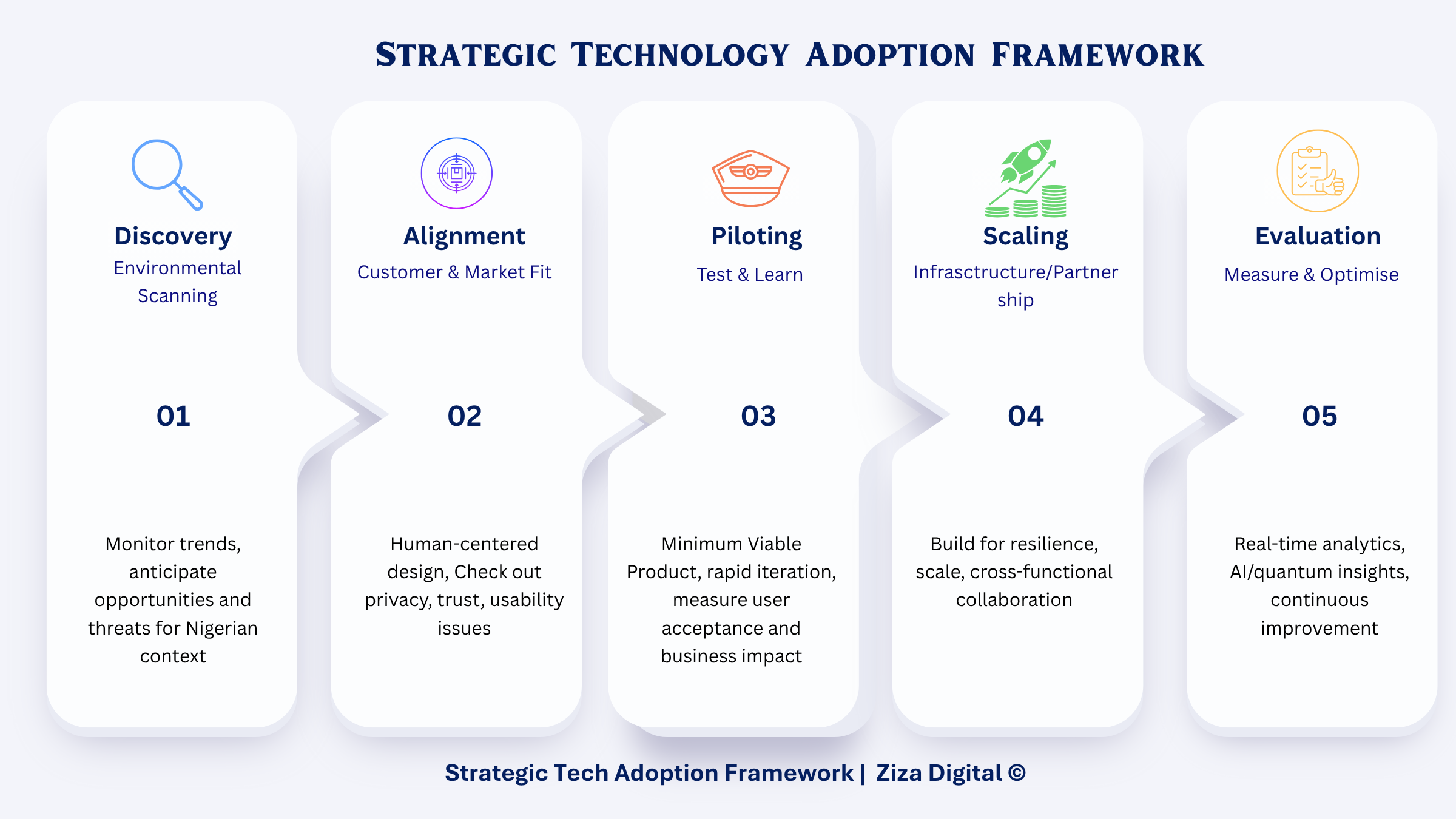
Drawing from the Technology Acceptance Model (TAM) Koul, S., & Eydgahi, A. (2017). and contemporary digital transformation models, CMOs and other C-Suite executives who are looking to adopt emerging technologies can leverage the framework below:
- Business-Customer Alignment: Center all adoption on genuine customer needs, preferences, and behavioral insight. Use design thinking and journey mapping to identify innovations that drive measurable value.
- Proof of Value and Piloting: Implement rapid prototyping, sandbox pilots, and measurement of ROI before full-scale deployment. Launch with minimum viable product (MVP) approach and iterate using real user data.
- Change Management and Skills Development: Communicate and train staff around new digital tools and ethics so that they can champion the adoption. Foster a culture of agility, adaptability, and experimentation.
- Secure Data Governance: Adopt privacy-by-design, transparent consent management, and robust cybersecurity for all MarTech deployments.
- Ecosystem Partnerships: Collaborate with technology providers, startups, regulators, and academia to co-create scalable solutions. Participate in industry standards and policy consultation processes.
- Measurement and Feedback: Apply data-driven KPIs and analytical models (using first-party and IoT/sensor data) to assess impact and regularly capture customer, partner, and community feedback for ongoing iteration.
- ESG and Purpose-Driven Marketing: Integrate environmental, social, and governance (ESG) principles, building trust, resilience, and long-term loyalty.
Conclusion
Emerging technologies offer a significant array of opportunities as well as strategic challenges for marketing leaders in Nigeria. In the years ahead, organizations that successfully integrate blockchain transparency, nanotechnology-driven product innovation, immersive AR/VR experiences, hyper-personalized IoT solutions, and Web3 community dynamics will thrive. These technologies should be viewed not just as tools, but as foundational elements of a resilient and innovative marketing strategy that can unlock genuine customer value, foster trust, and maintain a competitive edge in an increasingly globalized digital marketplace.
For Nigeria’s marketing leaders, the path forward is evident: act decisively, learn rapidly, invest in talent, and shape the future instead of passively awaiting its arrival. The technologies are already available; sustained relevance, impact, and leadership will hinge on how effectively they are utilized.
References
Bhardwaj, C. (2025, October 10). The rise of Blockchain in Marketing: Benefits & Challenges. Appinventiv. https://appinventiv.com/blog/blockchain-marketing/
Cars, W. V. (n.d.). Volvo reality app. volvo. https://www.willisvolvocars.com/.htm
Faster Capital. (2025, April 1). Nanotechnology and materials science: Nanotechnology applications in marketing: Exploring new frontiers – fastercapital. https://www.fastercapital.com/content/Nanotechnology-and-Materials-Science–Nanotechnology-Applications-in-Marketing–Exploring-New-Frontiers.html
Koul, S., & Eydgahi, A. (2017). A systematic review of technology adoption frameworks and their applications. Journal of Technology Management & Innovation, 12(4)
Mediaocean. (2018). Mediaocean and IBM partner to integrate blockchain across the media ecosystem. https://www.mediaocean.com/ibm-blockchain
Nike. (n.d.). Nike X RTFKT – Cryptokicks IRL Public Draw. Nike x RTFKT – Cryptokicks iRL Public Draw. Nike SNKRS. https://www.nike.com/launch/t/nike-x-rtfkt-cryptokicks-irl-public-draw
Rajamannar, R. (2021). Quantum Marketing: Mastering the New Marketing Mindset for tomorrow’s consumers. HarperCollins Leadership, an imprint of HarperCollins.
World Bank Group. 2019. Nigeria Digital Economy Diagnostic Report. Washington, DC: World Bank. License: Creative Commons Attribution CC BY 3.0 IGO.
Many professional services firms do not have a marketing department or team. Quite a few don’t even have a single dedicated individual who focuses on promoting their company.
Often, sales and marketing fall to the owner, director, CEO, COO, or a high-level company leader. They already have their hands full, and building a successful lead-generation strategy quickly becomes an afterthought.
While you need tactics that generate revenue now — you also know that focusing solely on the “here and now” will leave you constantly chasing the next lead.
Organisations that are looking to grow need to strategize their lead-generation into something repeatable and reliable in order to have business stability and predictable growth.
That’s where podcasts come in.
With the right approach, you can use your podcast episodes to connect with potential customers and build a relationship long before they even signify interest in your services. Podcasting gives you short-term returns while building content and relationships for long-term growth.
Let’s explore the details of how to use podcasts to connect with leads and see how you can reap the benefits for your organisation. Before we do that, let’s even understand what Podcasting is.
What Is Podcasting?
A podcast is a series of audio content episodes, focused on a particular theme. In a world where everyone is constantly on the move and people crave more information, podcasting has become a great way to share content and an important piece of the marketing pie.
The purpose of Podcasting is to create conversations that help to solve the pain points or challenges that your ideal prospects and/or clients face. These conversations can feature different guests and thought leaders who have expertise in the subject area. Some of these guests can even be Clients or prospects and it may lead to sales opportunities in the future.
Podcasting opens a door for you to create genuine relationships with industry experts, thought leaders, and your ideal clients. Asking prospects and clients to be your podcast guest allows you to break the ice and get one-on-one time with your target customers while also sharing real insights from people who have real experiences on the topic of discussion. For example, I was recently featured as a guest on the Picha Podcast where i shared insights on Influencer Marketing. You can listen on Picha blog or listen on Soundcloud
What is Account-Based Podcasting?
Account-based podcasting is a podcasting strategy that concentrates resources on a set of target accounts within a market and seeks to help solve the subject challenge for that market.
3 Benefits of Account Based Podcasting
Benefit #1: One-on-One Time With Your Ideal Customers
If you’ve ever done any prospecting like cold calling or cold emailing, you know how quickly people will give you the cold shoulder. It’s rare to come across someone who will respond positively to your message.
No one likes to receive some random sales pitch from someone they don’t know, so you’ll be ignored or worse. These days, if they choose to take offence, they can easily call you out on social media.
With account-based podcasting, you can make cold emailing work for you in a way that you couldn’t before. Instead of a sales pitch, you’re offering to promote them on your show for free.
Most people are flattered when asked for an interview. Because of that, it’s relatively easy to get people to be a guest on your podcast.
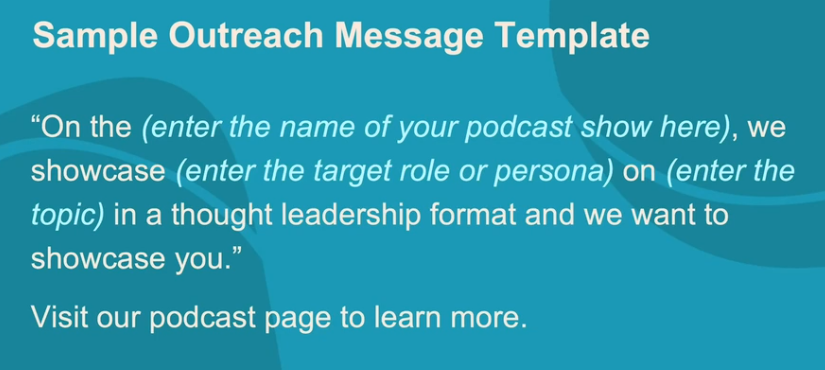
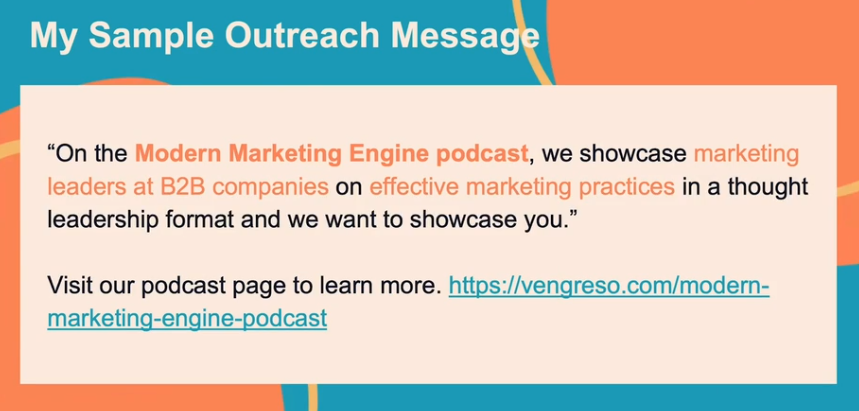
Use a template like the one below when you do your outreach, and you’ll likely have your first few guests lined up in no time. I’ve included a template shared by Bernie Borges at the last HubSpot Inbound 2020 Conference.
Sample Outreach Template
Template in Action
Using this strategy gets you talking with your ideal customers fast, and it enables you to build relationships with them naturally. You stand a much better chance of converting them into paying clients in the future should the need arise for them to use your services.
Benefit #2: Each Episode Creates Several Types of Content
When recording your podcast episodes, don’t make the mistake of recording just the audio. Record your interviews using video so that you can get the benefit of creating multiple types of content simultaneously.
You can upload the video to your YouTube channel and publish it on your website with a blog. You’ll also get the benefit of turning your video into an audio-only file so you can share it on all the podcasting channels.
If you use a program like Descript, you can generate a transcript of the video for use on your blog or podcast show notes. Descript even lets you clean up your “ums” and “uhs,” and fix mistakes without re-recording the episode.
Producing and publishing all this content allows you to generate backlinks and increase your website’s search engine ranking. In the meantime, with your podcast, you’re building authority in your industry, creating brand awareness, and opening doors to potential clients.
Benefit #3: It Establishes You as a Thought Leader
Have you ever noticed that when you hang around experts, other people assume you’re an expert too? If not, you’ll definitely start to notice it when you launch your new podcast show.
Not only will people assume you’re an expert, but over time, you’ll become one. The longer you do the show and the more people you interview, the more you’ll learn about your ideal customers.
You’ll come to understand them and their industry on a whole new level because you’ll continuously hear insiders’ perspectives from your guests.
As a bonus, you’ll clarify your messaging and improve your services with the more you learn about your customers.
Get Started With Account-Based Podcasting
At Ziza Digital, we’re experts at digital and Inbound marketing and regularly work with Professional Services forms to help create awareness, engage with prospects and generate leads. We know what it takes to implement an account-based podcasting strategy, and we can help you do all the heavy lifting that producing and publishing each episode takes. Book a free consultation now so you can start account-based podcasting sooner rather than later.
Marketing
Your professional services firm is most on the path to failure or indefinite struggle without a marketing strategy. Nevertheless, the presence of one does not guarantee success. There are a number of actions prone to endangering your brand perception, as well as negatively impacting your ROI.
In working with several professional services firms across Nigeria, we have identified 5 marketing mistakes that are common with these firms. Read on to learn these five mistakes and how to avoid them in your own organisation.
1. Not having a dedicated marketing team:
Professional Services firms often run marketing as an extension of the MD’s desk. This means that there is no dedicated marketing staff or team to do mind the task. In its stead is an MD who implements marketing tactics at his convenience and mostly in piece meals as he neither has the time nor the expertise to implement strategic marketing communications for the firm.
One implication of this is that the value gained from marketing in this kind of firm will be next to nothing and as time goes on, the MD might be inclined to think that marketing doesn’t achieve results. The budget invested in marketing in a firm like this will be wasted.
Another consequence is that if the firm has a strong competition that is focused on consistent marketing with a desk of dedicated and strong marketing professionals, it will only be a matter of time before the competitor overtakes the firm.
2. Long approval process:
This is especially true for firms that do not have a dedicated marketing team. The aftermath of which being the approval process for marketing projects will be tedious and hard as there is no one consciously looking out for these projects. Besides, professional services firms are conservative in nature and have long approval processes.
Marketing, on the other hand, moves at the speed of light and long approval processes may hinder marketing campaigns or projects that are time-sensitive; especially consumer-generated campaigns based on latest industry news or trends, some of which have potency of between one day to one week.
Waiting for the admin to pass it to the GM’s Secretary/PA who then has to weigh the importance and then presents it to the GM when other priorities have given way, which may be two weeks later and no longer relevant at that time.
3. Treating marketing as an afterthought:
Most professional service firms do not make allowance for marketing while planning for their firms. It is often treated as an afterthought and receives almost no attention.
This is a mistake that any firm looking to gain relevance and thrive should have no hands in.
Brands often make the mistake of treating marketing only as an afterthought to be looked into when it seems they are way in over their heads and are struggling to keep afloat. Implementing marketing only when the organisation has challenges only puts pressure on marketing to focus on short term goals and tactics like promos, price slash etc.
4. Not implementing marketing as a long-term project:
A number of the professional services firms that invest in marketing do so on an ad-hoc basis. They implement a project once in two years and for a short period of time and never consider it again until a distant future. Meanwhile, marketing is supposed to be a huge part of your everyday project in running the organisation.
In one study, it was found that all that is needed to put off a potential client is one moment of dissatisfaction usually from lack of service, speed of return on assignments, lack of insight or experience in a specific sector; all of which is an action inconsistent marketing projects promote.
Like I always say, marketing is a marathon, not a sprint. It is actually never done.
5. Lack of marketing budget:
Having things in motion to create content is only the first step. Even more important is the need to strategically have it appear in front of the right audience via hyper-targeted promotions.
For a firm where marketing was not planned for in the first place, there is almost always no budget set aside for it. Without an active budget, nothing gets implemented.
To quote Stuart H. Britt, “Doing business without advertising is like winking at a girl in the dark. You know what you’re doing, but nobody else does.”
You need a marketing budget where your marketing team can periodically dip their hands into to promote your firm’s content to garner the right amount and type of website traffic and leads that will fill your funnel and grow your business.
To correct this mistake, consider including a marketing budget to your firm’s annual budget, to be channeled towards paid advertising like Google Pay-Per-Click (PPC), search engine marketing (SEM) or LinkedIn/other social media sponsored updates are a great way to get your content before the right ‘eyeballs’ as you’re building your organic audience.
CONCLUSION
Developing a marketing strategy is vital for the survival and growth of any business. Without one, your efforts to attract and retain customers are likely to be hit-and-miss.
With an effective marketing plan in place, you’ll be able to straighten out such things as who your actual customers are versus who you thought they were, potential new growth opportunities, make viable marketing investments, and avoid these five plus other marketing mistakes that could hurt your firm’s lead generation opportunities and brand reputation.
Looking to set your marketing on track to maximise its impact on your firm? Book a free consultation with a member of our team to discuss how we can help.
What first comes to mind when you need to buy a mobile phone, replace your washing machine, locate a restaurant nearby, or reach out to a Law or Auditing Firm for consultation?
Google.
Specifically, the first page of Google, where your entries into the search engine will likely resemble:
“best phones (within your price range)”,
“best washing machines”
“restaurants near me”,
“best (name of service) firms near me.
The unique search pages that appear first—the ones you’re most likely to click on— are only able to do so by the power of SEO.
What is SEO?
Simply put, search engine optimization (SEO) is a strategy to ensure that when someone googles your service category, your firm’s website comes top.
Regardless of the niche of services you’re in— Engineering, Architecture, Telecommunications, HR, Fintech, etc., —your overall digital marketing plan ought to include a search engine optimization strategy for some relevance in today’s market. This way, when people search for your services, your firm appears on the first page of Google.
Here’s an example:
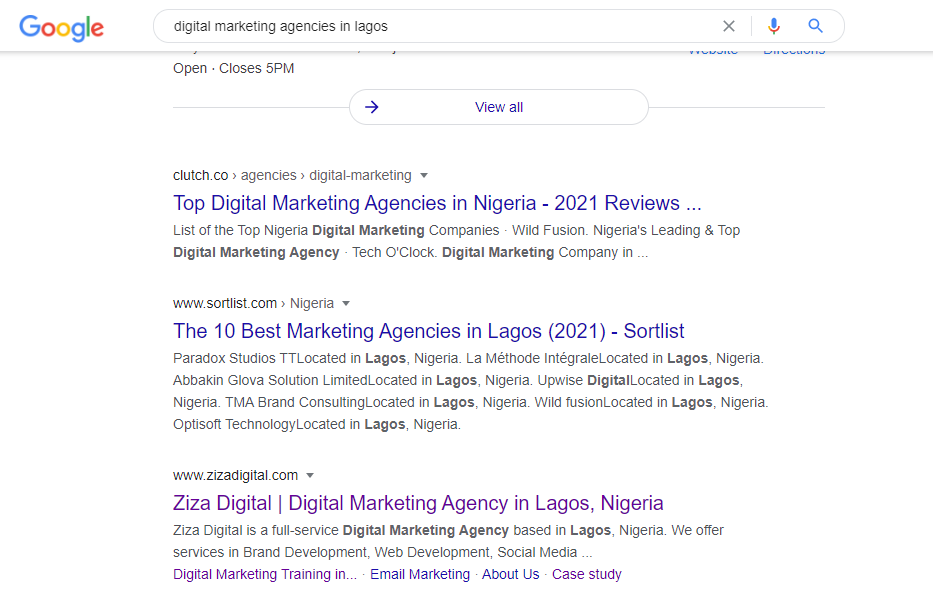
7 reasons professional services firms like yours should invest in SEO include:
SEO increases your brand visibility and ranking.
Visibility is a term that describes how prominent a particular domain is in search engine results while Ranking is the process that search engines use to determine where a particular web page in SERPs should come up.
In a recent study by HubSpot, it was found that 77% of people research a brand before engaging with it.
Lower search visibility occurs when a domain isn’t visible for many relevant search queries, interpreted as lower rankings. In a nutshell, your professional service firm is leaving money on the table by not positioning itself right (with SEO) and leveraging this audience of people who use search.
In the long run, your brand’s visibility and rankings will impact the main SEO objectives – traffic and conversions.
In a world where B2B buyers carry out a dozen searches, on average, before engaging with a brand, coupled with 18% more shoppers preferring Google to Amazon, investing in SEO is a smart move to increase the chances of your pages coming top, thereby positioning your brand throughout almost their entire buying journey.
2. SEO communicates with your target audience
Which would you rather do: invest in creating helpful resources and making helpful information more easily accessible to people looking for them, or making passes people might find intruding and annoying (cold calling, spam emails, interruptive ads, random billboards, and handbills) primarily because they didn’t ask for it in the first place?
Thankfully, one of the biggest advantages of SEO is that it’s an inbound marketing strategy. What this means is that unlike traditional (outbound) advertising channels, which involve reaching out to consumers whether they want to hear from you or not, inbound methods center on making it easy for your audience to find you when they want information.
Not only is this much more convenient for consumers, it also results in more qualified leads for your business. What is more effective than reaching out to a prospect with relevant answers while they’re already considering contracting a service you render?
In fact, in HubSpot’s most recent State of Inbound report, 59% of marketers said that inbound practices provided the highest quality leads for their sales teams.
Focus on attracting users who are actively looking for information related to your services, you’ll be much more effective in reaching your target audience.
3. SEO is a cost-effective way to do marketing
SEO gets more clicks than PPC. This is despite the fact that PPC ads appear above organic rankings.
A lot of work (obviously) goes into doing SEO right. But a mastery of the needful technicalities will make the digital world become your oyster.
When you consider that 71.33% of searches result in a click on an organic result on the first page, and the fact that you can market virtually all of your services for next to no cash out of your pocket, it would be an effort truly worth it.
Another cost-effective yet super-efficient way professional services firms can connect with their audience is via Podcasts. You can read all about it here.
4. Attributable & Measurable Organizational Growth
One of the many benefits of SEO is that it allows you to objectively track your company’s growth.
Relevant details like the duration visitors spend on your site, the number of pages they visit, etc. ’ll help your firm take more informed decisions to boost your market shares.
What’s more? While growth is a metric that every business will always strive for, it’s more than simply a badge of honor. Possessing the data of your business’s current growth (and potential for growth) is a stellar way to attract investors if you happen to be in need of funding, or take the decision to start another company.
5. SEO will help you build a long-term audience.
Paying for Ad placements; be it search engine marketing (SEM) pay-per-click, programmatic ads, and the likes, will only bring you short term results for a high price.
These modes of advertisements are not bad in themselves, but take the back seat as statistics prove that even if yours is a firm big enough to pull off running ads on multiple platforms 365 days of the year, SEO favours brand credibility and trust.
With SEO, you get to consistently provide your website visitors with the content they want, in place of having traffic downswing the moment an advert budget runs out, thereby building a community of clients. They’ll consider you a resource hub, the go-to firm, and not the intrusive one.
6. Overtake the Competition
So, chances are that your competitors make up the 61% of marketers who say “improving their SEO and improving their online presence is a top priority”. This means that they are likely already taking steps to establish high rankings in search results and if you’re not moving forward and improving your position, you’re losing ground to a competitor who is.
SEO is a widely acclaimed staple of any digital marketing strategy, which makes it a valuable tool you can’t afford to ignore for too long.
The earlier you get on board with an SEO strategy of your own, the higher your chances of keeping up with and ideally, moving ahead of your competitions.
7. SEO will help you make informed business decisions
In addition to advancing your brand visibility, establishing thought leadership, and garnering customers’ trust, SEO is also a major research resource.
The best part is that the same data that helps you understand customer behavior can be further expanded and used for a host of other marketing actions. The knowledge can be applied to the overall business strategy to shape the decisions your firm makes, resulting in bountiful ROI.
Once you figure out the consumer, converting them is easier work.
All you have to do is to segment your audiences, automate your marketing processes, and voila!
Conclusion:
Considering 93% of all web traffic comes from Google, it is only natural that the most coveted position for any business (website) is to rank on page one organically; a process known as SEO.
Having your firm rank on the first page of Google, gives you the bountiful benefits of consistent leads, calls, and customers, which is why achieving this feat can be challenging not to mention highly competitive. But like any great success, those results require a fair amount of time, effort, and SEO expertise.
Have you ever bounced out of a website?
Was it because the content wasn’t helpful? Or something else?
Think about those interesting pieces of content that kept you glued till you got to the comment section and got you feeling like; “Phew” I need more “What a piece of content!”.
Well, I have been there too.
Let me ask you…
Did you enjoy the article because of the degree of relevancy and expertise shown in the content? Or is there more to it?
“There should be more to it than just the content.” you are wondering, right?
The simple truth is, there is more!
Great content writers have found this and have mastered the art of using it to keep their readers glued to their articles.
The fact is that these experts don’t just write they “CONNECT”
You will agree with me that once you find unique content that you can connect with easily, It encourages you to read till the end
Bloggers use these bridge-phrases to add conversational value that not only grabs your attention but makes the article more like you are having a conversation!
This technique is so magnetic hence, you become so attached to the page that it becomes your go-to website for that topic of interest.
If your readers can connect, they will certainly come back for more and this, in turn, will attract more people -And of course, this is great for SEO (Thanks to google). You get ORGANIC TRAFFIC.
So what’s this technique?
It is called the “BUCKET BRIGADE”.
Huh!
Yes, I know you are wondering what this is, hold on, permit me to walk you through.
What does the term Bucket Brigade mean?
Bucket Brigades are intentional bridge words or phrases used by writers to hook the reader to keep reading. It encourages you to go on and on till the end of the article.
Let me ask you a question.
Have you ever come across these words in any content you read recently?
- Think about it for a minute
- I know the feeling
- Ok, I know what you are thinking.
- Now, look, this is crazy!
- Want to know the best part?
- What’s the bottom line?
- Here’s the deal
- Let’s jump right at it!
- It doesn’t stop there,
- Here is why
- Nevertheless
- Can you imagine?
- No problem!
- Let me show you how……
These words are called bucket brigades. They are used to smoothen the flow of content and to add conversational value. This writing technique is also known as the grease slide techniques
Like superglue, bloggers use these words as often as they write. They have mastered this act of using them strategically to keep you stuck to their pieces of content.
That’s why knowing how to apply these techniques is the most important part. These will help you keep the flow when you write content and keep the reader sliding through till the end of your article.
Let me explain.
Professional content writers use these connectors in 3 stages:
1. The Introduction
2. The Body
3. The Conclusion.
THE INTRODUCTION
It says (ATTENTION EVERYONE – Can I have your attention?)
Words used at this stage consists of both the (capture word/ phrase and question Phrase).
For me, I like to call it the imagining stage, a stage where you get into your reader’s mind and create a mental picture with an emotional experience.
It means – Using attention-grabbing questions and phrases like;
- Have you ever wondered?
- Have you ever found yourself?
- Are you a content writer looking to improve your writing skills?
- Have you noticed?
- Do you want to know how?
- Do you hate?
- Can you imagine?
- Do you know?
- You can also start with these;
- Check this out! Good news, Listen, Look, Hey! The fact has shown that.
In the IMAGINING STAGE, Phrases like (Picture this, imagine, I know the feeling, I can imagine, I know what you are thinking, I have been there too), are used to connect emotionally with the reader.
Once you have gotten their attention and created a mental image that connects with their emotions, you transit to the Body.
THE BODY – WHAT DO YOU HAVE TO SAY?
Yes, you now have my attention. What do you have to say?
At this stage, two things happen- THEY STAY OR THEY LEAVE.
If you want the first, Get down to business, answer your question, ask more questions, make sure to keep them hooked. (The relevance of our content matters a lot here)
- Use Phrases like
- Let’s get started,
- Let’s jump in!
- Let’s dig a little deeper.
- Let me show you how
- Let me explain
- First, let’s
- Let’s go
- Let’s dive in
- Here is how it works
- Do you want to know how it works?
Conjuncts like; besides, moreover, to begin with, that’s not all, in other cases, most of all, or even better, for instance, nevertheless, works magic.
Using disjunct like; honestly, obviously, clearly, quite simply, make no mistake about it, believe it or not, usually, believe it or not, personally, can add conversational value to your content.
Pausing for a moment will keep your reader in suspense. At this point, you could ask another question.
Now stop right there! Think for a moment, think about it like this, how is that, why? Consider this…
To add supporting information, make use of phrases like: Before we go any further, But first let’s, Before we go into that, back to what I was saying, Look at these examples, let’s see how this works, here are the details, ask yourself these details.
To share your points and offer solutions, use lines like:- the point here is, Here’s the big thing, my point is, want to know the best part? Here’s the clue, The key to, this great secret/tip/technique, Here is how you go about this, the answer is.
Don’t forget to make it look simple- people have a lot on their minds already. Use words like; Sounds easy enough yeah? It is simple, this is so simple,
Let’s move to the final part – The Conclusion.
CONCLUSION
Congratulations! You have been able to retain them, so what now? We move!
Let’s conclude what we started, so at this stage, you want to give them a parting gift or let’s call it a Final impression which will determine if you will get a standing ovation. So, you will need to wind up with a lasting impression.
Please note that more than the body, your Introduction, and your endings must be HIGHLY IMPRESSIVE because they have a significant impact on your reader.
What you will be doing here is simple – SUMMARIZE, LEAVE THEM THINKING, CALL TO ACTION.
Here are some phrases for a perfect finish:
TO SUMMARIZE, use (To sum up, to conclude, Let’s have a recap, In a nutshell, In essence)
TO LEAVE THEM THINKING, use (It is up to you, what are you waiting for, Do you want it? Don’t take my word for it, this choice is yours, it is your call, this is the point where you decide, don’t miss out on this, over to you, it is worth it?)
FOR CALL TO ACTION, use (give it a try, I’d like to know your thought, comment below, what do you think, share if this was helpful)
You may still be wondering why you should use a bucket brigade technique?
Here’s why.
1. It keeps your reader focused on your content, and this will increase the time your audience spends on your website (High Dwell-time). Do you know what this means? It means you get organic traffic and a low bounce rate.
Like I explained above, two things happen when someone lands on your website from a search engine. It is either “THEY EITHER STAY OR LEAVE”.
When Google notices that people spend time on your site, they believe it has something good and will give it a rank boosting.
When people leave (High bounce rate.) Google drops you down like trash!
2. It helps you connect emotionally with your audience.
3. If your readers enjoyed it and can connect with your content, they will come back and/or will refer someone. Do you know what this means? You get an above-average click-through rate and Lots of social shares and comments.
Sounds interesting, yeah?
Well, there are a lot more connector words available out there, so be on the lookout for more of these phrases in articles, papers, blog and emails.
Now that you understand what bucket brigades are and how they work, you should succeed when applying them.
Don’t forget that using grease-slide phrases will have no impact on IRRELEVANT CONTENT. Yes! Your content is essential.
And by the way, do you know that you can create your bucket brigade?
Now you know, Over to you!
Don’t forget to drop a comment below.
Looking for help with creating content for your blog or marketing campaigns? Click here to book a free consultation with a member of our team.
The beginning of a new year instigates an itch for most Marketing Managers and CEOs to implement new marketing programs for the year.
Halt!
Before you get out the markers and the whiteboards, have you audited your marketing efforts for 2020 vis-à-vis the business impact and realities?
While implementing new marketing programs for 2021 is a significant step expected of any brand that is serious about growth; auditing your 2020 marketing efforts will help improve the success of your 2021 marketing programs.
Make no mistake, we do not focus this audit on vanity metrics and how colourful the campaigns were, but on marketing’s impact on the business objectives and overall business growth. This audit differs from the general marketing audit which focuses on little wins like the number of social media followers, blog posts published, etc. We expect that the general audit for the marketing department should precede this marketing impact audit.
As a business owner or marketing manager that understands the value of growth, here are 3 reasons all brands need to perform a Marketing Impact Audit.
3 Reasons to Audit Your Marketing Efforts
1.Marketing Impact Audit will help you understand what worked in 2020. Technically, take a cue and implement more of what worked in the previous year.
2. It will help you understand what didn’t work. With this, you will know what marketing programs to reduce or perhaps totally take out of your calendar.
3. It will give an obvious clue to what we should add to the marketing plan for the current year, giving the trends and innovation you noticed in the previous year.
Now that we have established 3 reasons your brand needs to carry out a Marketing Impact Audit, here are 8 important questions you need to find answers to in auditing the impact of your marketing efforts for 2020 before you implement any marketing program in 2021.
8 Marketing Impact Audit Questions
1. Revenue: What product or services generated the most revenue in 2020?
This gives a sense of the products or services that your market really wants. With this information, you can dedicate your marketing efforts and budgets to push these products and services.
2. New Business: What is the volume of new business versus repeat business?
This question helps you understand the satisfaction of your current customers and may warrant research to see what your current customers actually think of your products or services. While getting new clients/customers is a grand thing, there may just be something scaring away your old clients. It is common knowledge that customer acquisition is an expensive venture and it is cheaper to keep old clients.
3. New Business: What sources did our new business come from last year?
This question helps unearth the best platform(s) to reach the target audience and helps to focus the marketing efforts on those platforms. It is an open secret that resources are finite and whatever is available must be channelled to the right path to yield optimum results.
4. Customer Behaviour: Has the target market shifted in their buying patterns?
Focusing on the target audience’s buying pattern is important as it shows what service they need at each point in time and helps in understanding how to improve your services to fit their buying patterns. For example, COVID-19 has made delivery service an important part of most brick-and-mortar products. If you run a restaurant and do not have delivery services, clearly, your market will be restricted to your location. Customers haven’t stopped buying food, they have simply moved to the vendor who can deliver the food to them.
5. Marketing Channels: What marketing channels worked better last year?
Clearly, all marketing channels are not born equal. And the channel that worked best for a Real Estate Firm may not necessarily work best for a restaurant business or an Insurance firm. Each firm should understand their best marketing channel from their business audit and then set out to maximise the use of the channel.
6. Market Segmentation: How did we perform in the various segments of our market? And which segment(-s) should we focus more on this year?
With this question, you can find out the market segment that is pulling its weight and the one that is lagging. You can decide to have incentives to improve the segment(s) lagging and also put things in place to sustain the segment that is doing well. Sometimes, you may decide to do away with a segment that has been lagging consistently for a certain number of years.
7. Marketing Tool: What tools worked better for us last year?
In a digitally driven world, marketing tools have become an essential part of marketing implementation and one can barely do much without them. While they do great work, they can sometimes cost a fortune and with the high number of marketing tools out there, it is important to constantly audit to know if the marketing tool is delivering great value to the organisation while taking urgent steps to remedy or replace it if it is not delivering.
8. Messaging: What are we known for in our market? Is that what we want to be known for? Is there a need to change the narrative?
Is the marketing message in tandem with the brand? Is the brand known for what it wants to be known for? Is the message restricting the growth or enhancing it? Is there a need to change the messaging?
In a nutshell,
While these questions aren’t exhaustive, starting with these can help set your 2021 Marketing programs on the right path. Need to jump into your brand auditing right away, click here to download the full version of our Marketing Impact Audit Template.
This is the season where marketing managers and CEOs draw up a digital marketing budget for the upcoming year and the question that usually comes up at a time like this is: what should digital marketing cost?
And what must be included in next year’s budget?
For many C-suite managers, an exact figure and the risk analysis is all they are waiting for. This exact amount can easily be filled into the blank spaces in the budget template.
Unfortunately, it is not that easy! Because , there isn’t a fixed cost. The cost of digital marketing depends on a lot of variables. For clarity sake, I will outline the platforms, the variables involved and estimate for you a range of costs for each one. That way, you can decide what to budget in line with your marketing objectives and what your organisation can afford.
What Does Social Media Marketing Cost?
The average cost for an Agency to manage your Social media pages can range from N250,000 (Two Hundred and Fifty Thousand Naira) and above depending on:
1. The number of platforms – Would you like to be on Instagram, Twitter, Facebook, Pinterest, YouTube, Snapchat, etc.; or only a few of them?
2. The frequency of posts – Would you like to have three posts per week or three posts per day?
3. The kind of posts – Will the Agency be developing videos, GIFs, or only text and graphics
4. The Scope of work – Will this cover community management?
It must be noted that this does not include media cost that mostly goes to the platform owners for advertising and post sponsorship. Nor does it include the fee for Influencer marketing. Those will have to be treated separately and budgeted for accordingly when the need arises.
The cost of engaging an influencer usually depends on the popularity or brand equity of the influencer and the scope of work required. It can range from N20,000 per post to N300,000 and can go as high as 1 million naira if the Influencer is creating the content.
For Social Media advertising cost, you can budget an average of $0.30 per click for Facebook; $0.50 for Instagram, and $2.50 for LinkedIn. Yes, I can see you rolling your eyes ?, LinkedIn is super expensive.
But the truth is, it gives more quality leads than Facebook, Twitter and Instagram combined. However, it also depends on the industry of the brand that is advertising.
What Does Email Marketing Cost?
The basic cost of email marketing is divided into two;
1. Email Marketing Software cost – Your email marketing software is the main engine behind email marketing and every business needs a reliable software to run email marketing campaigns. There are several email marketing software solutions but the average cost can range from $9 and above for 1,000 contacts. However, as your email contacts increase, so will your software subscription cost.
Also, there will be a consequential increase if you would like to move your email marketing a step further to marketing automation, A/B Testing etc.
1. Email Content Development Cost – while the software is the engine that runs email marketing, the content is the lubricant that ensures the engine moves accordingly. Good content will increase your open rate and ultimately your click-through rate. You can budget an average of N250,000 per month for email marketing content development. This can get you an average of 4 email campaigns and slightly higher if this includes email sequences which is an important part of marketing automation.
Good content for each email campaign will include:
- The email copy
- The title
- The Call-to-action
- The preview text
What Does Google Advertising Cost?
Google Advertising is divided into two:
- Google Display Network which shows graphic Ads across several websites
- Google Search Network that shows text ads when someone searches Google for relevant keywords.
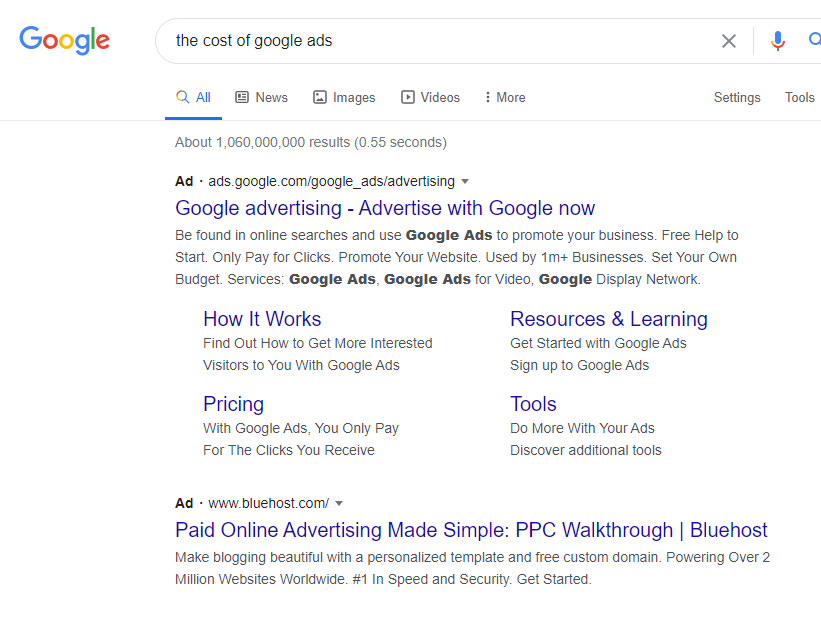
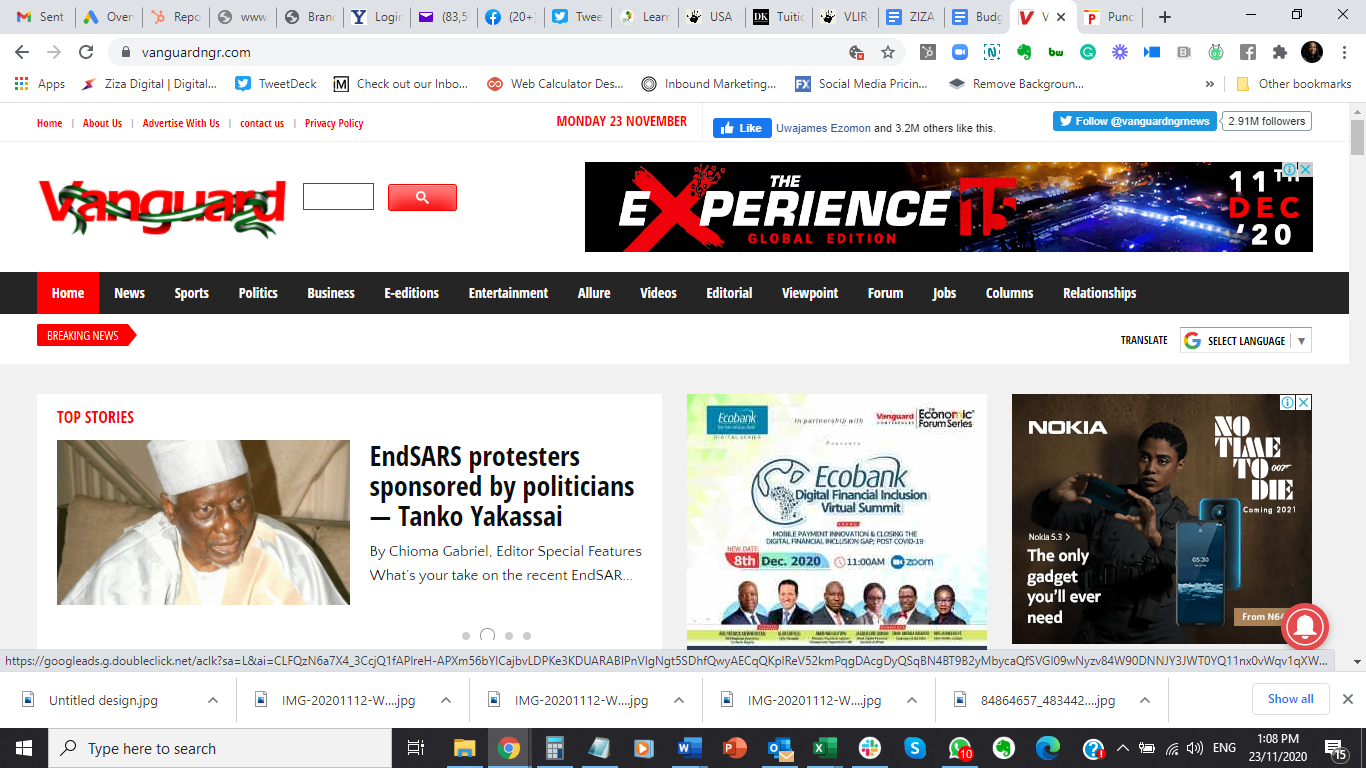
The average cost-per-click (CPC) for Google display network ranges from $0.40 – $1.20 while the average cost per click (CPC) for Google Search Network is $1 – $5 depending on the keywords you are bidding for, the industry, the location, and the google optimisation score.
In addition to the media budget, you will need to pay the Agency you are partnering with for the PPC Management. PPC Management is charged at a percentage of the Ad budget.
The fee charged for PPC management can range between 10% to 25% of the Google Advertising budget depending on the relationship between the Client and the Agency and the amount of work required.
In some cases, you may need to also budget for a PPC software that is used for the management of PPC campaigns but this is not compulsory.
On average, small businesses spend around $3,500 (Three thousand, five hundred dollars) a month on Google Ads. This is not cast in stone and can be customised to fit the budget that the client can afford.
What does Website Development Cost?
The cost of developing a good website in Nigeria costs between N200,000 and N1,000,000. The actual cost of the website will depend on the following variables:
1. Will the website be developed from scratch or is the developer using a template?
2. Will it be an E-commerce website or an informational website?
3. How many pages will the website have?
4. Will SEO be implemented on the website?
While some people generally advertise that they can build a website for N20,000 (Twenty Thousand Naira), the quality of that kind of website can certainly not be compared to professional websites.
Do note that the cost of developing a website does not include the cost of buying the domain name, the hosting, and SSL. Your domain name is your organisation’s address on the web while the Hosting is the container that holds the domain files. This is where the website will be seated.
All organisations need a domain name to have a website. Your domain name is www.yourcompanyname.com. Both the domain name and hosting are usually provided by a hosting provider like Hostgator.com, Godaddy.com, whogohost.com etc.
The average cost of a domain name can range from $9 to $15 depending on the kind of domain name. In some cases where the domain has been parked (bought by someone else who is willing to resell), the domain name can sell for as high as $50,000 (Fifty thousand dollars) – Yes, this isn’t a mistake – Fifty Thousand Dollars?!
Some domains are also classified as premium and command a higher fee than the average domain cost.
While the cost of building a website is a one-off cost, you will need to renew your domain and your hosting annually. This fee will need to be paid to your hosting provider.
In some cases where the business does not have a dedicated Brand/Marketing Manager or Writer, you may need to pay for Website Content Development as your website needs good content to communicate your brand equity and generate leads for you. This cost can be included in the website development cost if discussed at the inception of the project.
Once the website has been completed and handed over to the organisation, there is a need for the organisation to retain the services of a website Administrator to manage the website continuously. This person will be responsible for updating plugins, updating content, publishing posts, etc. This person needs not be a staff, he/she can be a freelancer or an Agency that manages websites.
The website developer can also be retained as the Website administrator but will need to be put on a monthly retainer for this as the cost of building a website does not include continuous website management.
What Does Search Engine Optimisation Cost?
This is perhaps the most straightforward one. The average cost of optimising 10 keywords is between N100,000 and N300,000. This includes both the on-page and off-page SEO which covers listing, meta tags, PDF submission, Social bookmarking, article promotion, etc. As the number of keywords increases, so does the cost.
It is important to understand that organic SEO is a long-term project and requires between 4-6months of constant work to rank selected keywords. This doesn’t mean that work stops after 6 months, organic optimisation requires consistent work to reach the first page and stay there.
Now that you have been introduced to the various elements of digital marketing and their cost as stand-alone platforms; the next question is whether you have the personnel in-house to achieve the goal…and you may then wonder what the cost of getting an Agency on retainer to provide integrated digital marketing services covering all platforms relevant for your brand will be?
What Does Integrated Digital Marketing Cost?
Individual digital platforms are great to reach your target audience but to get tangible value out of digital marketing, you need to focus on integrated digital marketing which uses the integrated approach to generate awareness, engage with your prospects, generate leads, and build brand equity.
For example, you want to incorporate Blogging, Social media, Google Ads, Email Marketing, Marketing Automation, Search Engine Optimisation, etc. for your brand.
In this case, you will need an Agency that will dedicate a team with experience in the different areas of digital marketing to manage your brand. Businesses sometimes make the mistake of hiring one person to perform all digital marketing roles – Content development, design, website management, PPC Management, SEO, etc. Check out our blog post on building a digital marketing team here.
The average cost for full strategic digital marketing monthly retainership ranges from N800,000 – N5 million depending on the scope of work and the number of personnel required to implement it.
In addition to the Agency retainership fee which is paid monthly, you will need to set aside a media budget for third-party platforms like Google Ads, Facebook Ads, Yahoo Ads, etc.
You will also need to set aside a budget for marketing software as these are the tools required to implement your digital marketing strategy. While there are different software for the different aspects of digital marketing, there are also several full-stack marketing software that covers all areas of marketing and one subscription will take care of your email marketing, Landing page, Chatbots, SEO, PPC, etc. An example of this is HubSpot.
The average full-stack marketing software costs between $250 to $5000 depending on the platform, the number of contacts, the number of users, the capability of the platform, etc.
The Advantages of Digital Marketing
Budget Flexibility – While the costs for the various platforms have been listed, it is important to note that you can decide how much to spend on digital marketing as the budget is very flexible. You can program your Facebook Ads to run for $50 and once the budget is exhausted, the Ad stops.
Real-Time Analytics – You can also get real-time analytics which tells you which platform is doing great and which one needs to be fine-tuned or stopped altogether.
Not Dependent on Company Size – Implementing Digital Marketing is a fantastic marketing decision irrespective of the business size and industry as it has varied platforms and tactics. A one-man organisation can implement digital marketing just like a 500-man organisation.
Looking for help with implementing digital marketing for your organisation? Book a free consultation with any of our consultants to learn how your brand can create awareness, engage with prospects, and generate leads.
Most professional services firms clearly understand the benefits that digital marketing can bring to their business. In any case, it is obvious to even a blind man that people are spending more time online than they previously did and Covid-19 has further increased the time spent online.
While knowing the benefits is fine, implementing it for your firm in order to enjoy these benefits is quite a different story.
If you are a custodian of a professional services brand and would like to implement Digital Marketing for your business, here is where to start.
1. Identify Your Business Goals
The right place to start is strategically highlighting your firm’s business goals- what are you looking to achieve? Visibility? Leads? Conversions? In some cases, it may be all 3.
Whatever your goals may be, have them spelt out in detail, as this will enable you to target and measure success or otherwise of your actions better.
2. Create your Digital Marketing Strategy
It’s no secret that your line of work makes you besties with documents of several pages, but this is not one of such.
Putting together a strategy for your firm is simply a task that requires you to put aside some planning and thinking time to answer a few critical questions, and provide answers to some others. This exercise will help you identify your businesses’ purpose and to bring a focus for your digital marketing efforts. It will provide a framework, a guidance for the entirety of your marketing actions.
A competent digital marketing strategy has four essential elements:
A. Differentiators: What sets you apart from the other Law,
Engineering, HR, Accounting or Consulting firms? What is your unique selling point?
B. Market Positioning: This is an offshoot of your differentiators. Your market positioning provides your audiences with a cohesive and compelling story they need to prefer your firm over your competitors.
C. Key messages: For success on this route, you ought to have key messages for each of your unique audiences. The same
message for a regular client being served to a prospective influencer won’t cut it.
D. Content Strategy: Once you have documented your overall
strategy, the next step is to select the right content strategy and tactics you will use to deliver key messages to your target audiences. This is the mode through which you will communicate your expertise, build trust, and demonstrate to potential clients how you can help them. Is it via videos, blog posts, infographics, email marketing, podcasts, etc. or just two or all of these? What tone will it carry? How often will you share?
Furthermore, it is point worthy to note that social media is an integral part of any digital marketing strategy. In defining your Social Media core, you will need to provide answers to some of the questions below:
Who is my target audience?
This will depend on the kind of customers you are looking to get into business with and/or how much you are willing to invest in digital marketing. Whatever you do, you want to go where your target audience is most comfortable. For most professional services firms, LinkedIn and Twitter are always good social media platforms.
What is my message?
What themes, topics, or narrative will my content be based on?
What channels can I realistically commit to?
If the Noun ‘impact’ excites you, then you should consider conducting a
thorough research and deciding based on the platforms you can realistically commit to and the one where your target audience is most comfortable with. There are lots of Social Media platforms and if you do not have the personnel and investment to cover all, it is best to select a few. It is not a good practice to spread yourself thin.
What am I trying to achieve on each of these channels?
how else would you measure your wins unless you first clearly spell
out your aim?
How will I measure my success?
Evaluation is essential and you should know from the beginning, the metrics you are going to measure to judge digital marketing drive successful.
Consider this a ‘welcome package’: How to Develop A Digital Marketing Strategy (Template Included)
3. Conduct a Target Audience Research
Another important step in putting together a digital marketing strategy for a professional service firm is conducting a detailed target audience research.
There is no business if you don’t know who you’re selling to. Your target audience research will cut across your current and potential clients, referral sources, and industry influencers, and each will go as detailed as their unique behavioural patterns – who they are, their pain points, what they are looking to achieve, how they spend their free time, yes, that detailed.
Ultimately, there are two kinds of research you can do. The first approach is the Secondary Research, which is simply sampling your target audience based on research already carried out by a similar firm in your field. The other is the Primary Research, which requires you to conduct an original study of your target audience.
A combination of both research styles is known to birth the best results. You get a rounded well-informed view of your audience, making your digital marketing efforts more of a science than an amateur guessing game.
4. Set Specific Goals and Determine How You Will Measure Them
When it comes to measuring how well you are faring in the pursuit of your goals, it is important to do so using the right metrics, and not have your analytics based on/limited to vanity metrics like the number of likes, followers, shares, views, etc.
Check out this article on the real marketing metrics you should measure for accurate data.
5. Use a Marketing Software
Effective digital marketing for professional services firms is based on three pillars – Strategy, Content and Software. The Software is the tool that drives the implementation of the strategy and the content and having the right software cannot be overemphasized.
A marketing tool like Hubspot offers you a platform to build landing pages for your campaigns, share your social posts and measure them, reach out to your prospects and customers through email marketing, research and grow your SEO visibility, build sequences, marketing automation, CRM etc.
If you are still running your marketing manually, then you should consider getting a software to multiply the success of your digital marketing efforts.
IN CONCLUSION:
What better season to take a swing in the direction of digital marketing than in these times of Covid-19 when physical sales and interaction is limited and people are spending more time online?
With a solid inbound marketing strategy and a formidable digital team and/or agency to help implement the day to day deliverables, you are well on your way to making your brand the top-of-mind choice for your industry.
Looking for help in putting together a digital marketing strategy for your firm and implementing it for success? Book a free consultation with any of our consultants here.
Lead generation is the process of attracting strangers and prospects into your business’ contact management system, with the aim of making them instant or future customers.
Thanks to the Covid-19 pandemic, engagement and sales have most likely slowed down for your brand, for some businesses, it is actually non-existent. Several experts have predicted that there is likely to be a recession post-COVID-19. Some have gone on to say that there may be a devaluation of currencies, a hike in inflation rates and a total market shakeup. With predictions like these, businesses are on the tip of their chairs and are wondering, what next post Covid-19? What are the salient things we need to implement to help us weather the storm?
Chances are you will need to generate new leads for a fast and powerful comeback. Wipe those sweat beads, we’ve got you. Below are seven tested-and-true lead magnets that will fetch your business hot leads post the COVID-19 pandemic:
1. Value-adding Videos
HubSpot reports that customers are four times more likely to click on a video than read about a product, and 52% of marketers around the world name video as the content with the best ROI.
Make a short video- how to…, a DIY, or one showcasing fancy ways to use your product. The agenda is to tackle a problem or create value for a prospect. Provided he/she learns something useful from your site or social media page, the next time they have a need related to the service you provide, they are most likely to head your way, and depending on what this need might be, they will be ready and willing to convert.
You can also try the initial 2-3 minutes for free to get them hooked, and then ask them to drop an email address to continue watching.
Cheatsheets
Cheat sheets are simple and concise guides proffering insights on how a task might be carried out. They are similar to e-books but only more comprehensive, as all the focus is on how to perform an action. No schooling on why it should be done, nothing ambiguous or time-consuming, just the best and quickest way to get it done.
Potential formats for cheat sheets might include:
- Step-by-step guides on particular tasks (e.g. How to setup a chat bot on your website)
- Templates (e.g., How to develop a digital marketing strategy (template included, Tax Calculation Template)
- Checklists (e.g., Content promotion checklist)
3. Downloadable Content
The good thing about downloadable content is that they are super affordable and easy to create. In fact, it is as easy as converting one of your blog posts into a pdf and position it as a lead magnet. You just have to stick to the premium rule: offer value. Keep in mind the stage of the and the need for you to offer real insights. If someone gives you their contact information, it’s only fair you provide some good enough value in return. Besides, lead generation is only a part of your grand marketing plan. Without a convincing reason to ride with you, they most likely will leave the sales funnel, which I’m sure is not something you are enthusiastic to see happen.
4. Trial period
It is not uncommon to find prospects adamant to convert until they have confirmed a product or service is right for them. For such potential customers, a trial tames their fears.
This is also a grand opportunity for you to strategically make your service one so valuable they can’t or don’t want to live without.
Discounts
A good deal is always an easy way to get lead traffic. I mean, who doesn’t smile at the sight of a discounted offer? The bottom line is everyone appreciates a deal. Therefore, placing a discount on products/services you offer can be a great way to push someone over the edge not only into sharing their contact information with you, but also to stick with you if not for your great services, for future discounts and promotions.
Quizzes
How many times have you clicked on a quiz to figure out how well your friends know you or what you would look like with a different colour of hair on?
Provided you are able to tie them to your brand, quizzes can be a fun way to engage your audience and scoop leads.
This kind of lead generation tactic can bring a wealth of resourceful insight into your overall inbound marketing activities.
7. Host a giveaway
Giveaways are one of the chief most successful lead generation practices of all time. Indisputable is the fact that it is a popular way to generate a bunch of stale leads that do not benefit your business, but if properly carried out, chances of this happening can be greatly minimized.
The secret recipe is to ensure that what you’re giving away is something people actually want; something of value that relates to your line of business.
A giveaway generates leads via social media engagement and email subscriptions, which is a win-win for you and your prospects. On the bright side, it doesn’t matter so much if a user wins or loses the giveaway, they will continue to engage with your brand in hopes of getting lucky enough to win future giveaways.
01
Growth Marketing Services
Our Growth Marketing Service utilizes multiple digital marketing tactics and platforms to create awareness, engage with prospects and generate leads.
Get Started
02
Lead Generation Projects
Looking to generate leads for your business? We can help. Our lead generation service focuses on identifying your ideal target audience and creating lead magnets to attract them to your business.
Get Started 03
Mobile Marketing
Let’s help you reach your consumers through mobile marketing using various mobile platforms like: WhatsApp, SMS, Mobile Apps, After call Summary Adverts
Get Started 04
Professional Services Marketing
Firms that offer Professional Services cannot be promoted the same way that product brands are promoted.
Get Started 05
Social Media Marketing
Your customers and prospects are on Social media. Your brand should be too.
Get Started 06
Website Development
Your website is your online office address and your 24-hour sales tool.
Get Started 07
Search Engine Optimisation
There are 3.5 billion searches on Google daily. Clearly, consumers are turning more to search engines help them take buying decisions.
Get Started 08
Brand Development
All products need to be developed into brands that gives them a distinct identity in the minds of the customers.
Get Started 09
Email Marketing
Several research has proven that email marketing still delivers a higher return on investment than any other Digital Marketing medium.
Get Started 10
Digital Advertising
Looking to run advertising for your brand across digital platforms? We can help. We develop and implement digital advertising campaigns across multiple digital platforms.
Get Started 11
Content Marketing
Content drives all digital marketing elements. And great content added to good design can drive significant sales and engagement.
Get Started Marketing
Insights