
Marketing
Insights


Executive summary
As the digital revolution accelerates, the integration of emerging technologies into the marketing space is reshaping how brands compete, engage, and build value with customers across the globe. The conversation has shifted beyond AI to encompass a broader set of innovations: blockchain, nanotechnology, augmented reality (AR), virtual reality (VR), the Internet of Things (IoT), the metaverse, 5G and quantum computing, among others. These advances are redefining customer experience, stakeholder trust, operational efficiency, and market differentiation.
For Nigerian marketing executives and leadership teams, understanding how to strategically adopt and leverage these technologies is now a critical imperative. This article presents an analysis of the emerging technology landscape in marketing, citing real-life examples around the world. It is designed to support C-suite and senior decision-makers in charting a future-ready path to digital transformation and customer-centric value creation.
Introduction
A seismic shift in the way we use and interact with the digital space is taking hold… the ‘how,’ ‘what,’ and ‘why’ of communication are about to be recalibrated (The Future Laboratory & Microsoft 2023).
For marketing leaders, this is not just a prediction, it is a strategic reality already reshaping how brands connect with audiences. From blockchain-enabled transparency to immersive AR/VR product experiences, nanotechnology-driven personalization, the Internet of Things (IoT) shelf prediction, metaverse, 5G and even quantum computing, the rules of engagement are being rewritten. These advances are redefining customer experience, stakeholder trust, operational efficiency, and market differentiation.
For the Nigerian market, the context is unique: rapid urbanization, a digitally savvy youth population, persistent infrastructure challenges, evolving regulatory landscapes, and a swelling tech ecosystem (World Bank Group. 2019). The challenge for senior marketers, particularly in dynamic markets like Nigeria, is not whether these technologies will disrupt the landscape, but how to harness them to drive measurable growth, trust, and long-term brand equity.
Beyond Generative AI: Leveraging Robust Emerging Technologies
Although AI-driven content development, personalization and analytics have dominated headlines, Generative AI is only the top layer. The most future-proof strategies now require a panoramic view that includes blockchain, nanotechnology, immersive realities (AR/VR), IoT, and more.
In taking the robust emerging technologies approach, here are key technology domains to consider:
Blockchain in Marketing
Blockchain technology is rapidly moving from concept to real-world impact in digital marketing. Its core strengths lie in providing immutable, decentralized records of transactions, bringing unparalleled transparency, trust, and anti-fraud capabilities to data management and customer engagement.
Blockchain’s highest-impact marketing use case is disintermediating programmatic media buying: a shared, tamper-evident ledger (with smart-contract settlement) brings end-to-end fee transparency, verifies inventory, and automates reconciliation, allowing marketers to remove unnecessary middlemen and direct more spend to quality publishers (Mediaocean, 2018).
Another example of Blockchain use in marketing is Nike’s “CryptoKicks” project, protected by patents, integrates blockchain tokens with physical sneakers to guarantee authenticity, enable resale royalty tracking, and even allow customers to “breed” new virtual-physical shoe designs (Nike n.d).
Nanotechnology in Marketing
Nanotechnology offers disruptive breakthroughs far beyond industrial manufacturing, directly impacting consumer perception, product differentiation, and marketing experiences.
It can be used for smart packaging, interactive display spaces, and product authenticity. For example, Nanomaterials with embedded sensors can track product freshness, detect tampering, and communicate with customer smartphones, enabling at-home experiences (Faster Capital, 2025).
Augmented Reality (AR) Marketing
Augmented reality is redefining the discovery phase by turning static product pages into interactive, try-before-you-buy experiences—letting shoppers visualize, fit, and test products in context. This reduces uncertainty, builds confidence, and shifts persuasion earlier in the funnel. (Rajamannar, 2021)
Here are some AR in marketing examples:
While major global brands lead in adoption, African brands should brace up as device penetration, 5G rollout, and digital literacy improve.
Virtual Reality (VR) Marketing
Virtual reality immerses users in fully digital environments that are separate from the physical world. For example, a headset can place a user inside a simulated game, training module, or retail setting.
VR is fast evolving from a gaming niche to an essential storytelling and engagement tool in the marketing sector. Its adoption has been constrained by device bulk and cost, concentrating use among professional or niche segments. However, recent advances indicate a shift toward lighter, more wearable, and more affordable devices, including smart glasses, which broadens access and normalizes everyday use.
As discussed in Rajamannar’s Quantum Marketing, this trajectory positions VR as a credible instrument for product discovery and demonstration with strategic implications for media investment, channel design, and first-party data capture.
A notable example of a VR campaign is Volvo’s virtual test-drive campaign which drove tens of thousands of app downloads and increased purchase queries for the XC90 SUV (Cars n.d).
Internet of Things (IoT) Marketing
IoT connects physical products and environments to the marketing ecosystem, generating real-time, contextual data and enabling unique, timely content or service delivery. This can be very useful in industries like Logistics, FMCG etc.
However, data privacy and security remain paramount. Marketers must embed privacy-by-design and secure communications, especially given Nigeria’s tightening data protection laws.
Metaverse and Web3 Marketing
The metaverse; integrating AR, VR, blockchain, and persistent digital worlds, represents a new frontier for savvy brands. It offers opportunities for virtual showrooms, branded worlds, digital product drops, and community-centric engagement.
Although it is still in its early stages, Nigeria’s youthful demographic, leading crypto adoption rate, social gaming culture, and creative industries suggests that it may seamlessly embrace metaverse.
5G and Edge Computing for Marketing
5G’s transformative power lies in enabling real-time, high-bandwidth, low-latency marketing experiences, especially for mobile-based AR, VR, and IoT deployments, as well as live streaming and two-way engagement at scale. It enables seamless streaming of interactive ads and virtual product experiences, which are critical for AR/VR retail and event campaigns. It powers real-time, location-aware push notifications and context-driven offers.
With the recent rollout of 5G (led by MTN and Airtel) across the country, this will open new doors for next-gen experiences.
Quantum Computing in Marketing
Quantum computing, while still in its developmental stages, offers incredible long-term potential for the marketing industry. It can process complex, high-volume data orders of magnitude faster than conventional computing, think Black Friday orders. It enables richer predictive modeling for segmentation, and optimization, providing actionable market insights at unprecedented speed and accuracy.
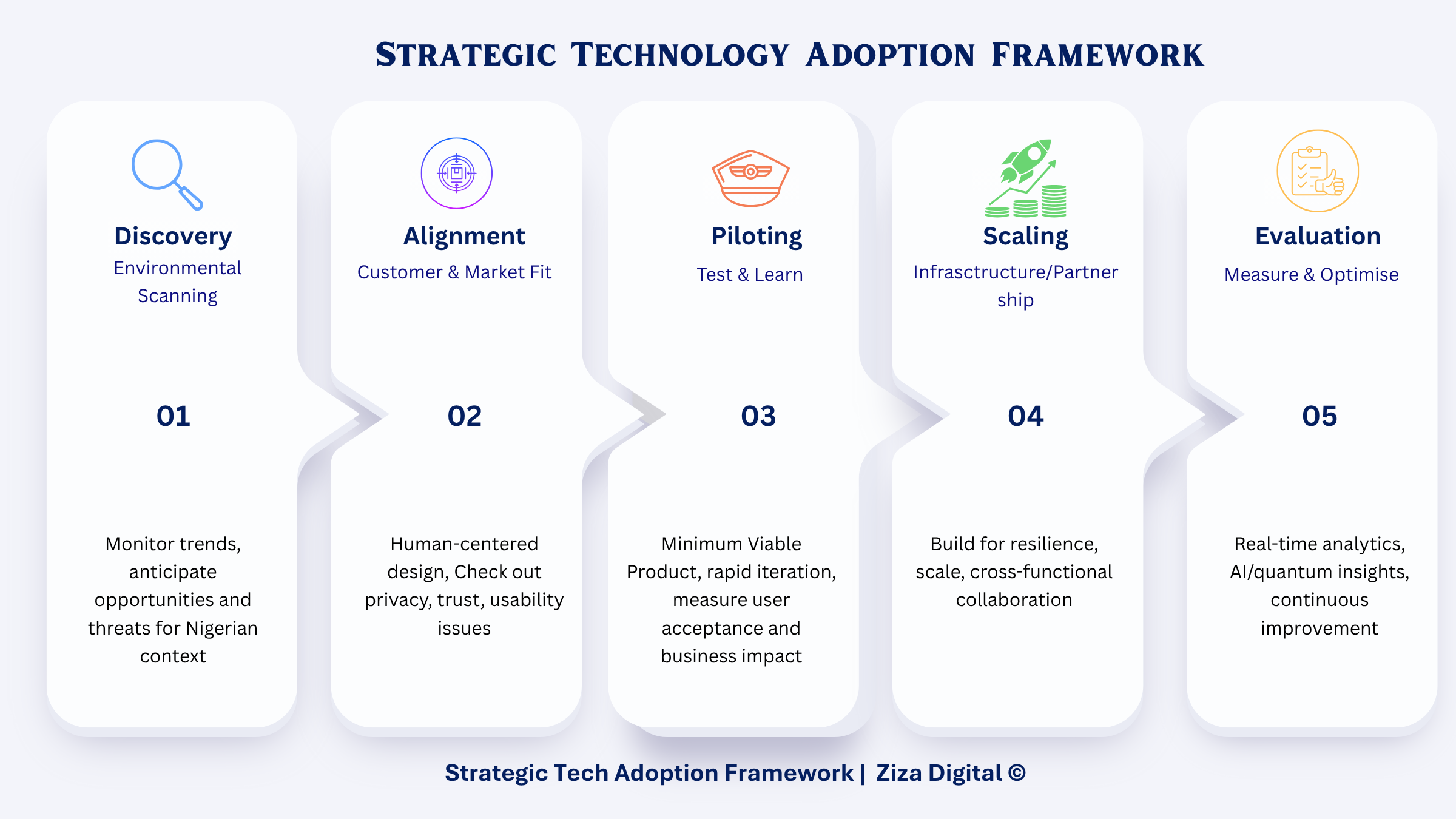
Strategic Framework for Emerging Tech Adoption
Drawing from the Technology Acceptance Model (TAM) Koul, S., & Eydgahi, A. (2017). and contemporary digital transformation models, CMOs and other C-Suite executives who are looking to adopt emerging technologies can leverage the framework below:
Conclusion
Emerging technologies offer a significant array of opportunities as well as strategic challenges for marketing leaders in Nigeria. In the years ahead, organizations that successfully integrate blockchain transparency, nanotechnology-driven product innovation, immersive AR/VR experiences, hyper-personalized IoT solutions, and Web3 community dynamics will thrive. These technologies should be viewed not just as tools, but as foundational elements of a resilient and innovative marketing strategy that can unlock genuine customer value, foster trust, and maintain a competitive edge in an increasingly globalized digital marketplace.
For Nigeria’s marketing leaders, the path forward is evident: act decisively, learn rapidly, invest in talent, and shape the future instead of passively awaiting its arrival. The technologies are already available; sustained relevance, impact, and leadership will hinge on how effectively they are utilized.
References
Bhardwaj, C. (2025, October 10). The rise of Blockchain in Marketing: Benefits & Challenges. Appinventiv. https://appinventiv.com/blog/blockchain-marketing/
Cars, W. V. (n.d.). Volvo reality app. volvo. https://www.willisvolvocars.com/.htm
Faster Capital. (2025, April 1). Nanotechnology and materials science: Nanotechnology applications in marketing: Exploring new frontiers – fastercapital. https://www.fastercapital.com/content/Nanotechnology-and-Materials-Science–Nanotechnology-Applications-in-Marketing–Exploring-New-Frontiers.html
Koul, S., & Eydgahi, A. (2017). A systematic review of technology adoption frameworks and their applications. Journal of Technology Management & Innovation, 12(4)
Mediaocean. (2018). Mediaocean and IBM partner to integrate blockchain across the media ecosystem. https://www.mediaocean.com/ibm-blockchain
Nike. (n.d.). Nike X RTFKT – Cryptokicks IRL Public Draw. Nike x RTFKT – Cryptokicks iRL Public Draw. Nike SNKRS. https://www.nike.com/launch/t/nike-x-rtfkt-cryptokicks-irl-public-draw
Rajamannar, R. (2021). Quantum Marketing: Mastering the New Marketing Mindset for tomorrow’s consumers. HarperCollins Leadership, an imprint of HarperCollins.
World Bank Group. 2019. Nigeria Digital Economy Diagnostic Report. Washington, DC: World Bank. License: Creative Commons Attribution CC BY 3.0 IGO.